Enter Your Link or Content
Paste a website URL, type plain text, enter WiFi credentials, add a phone number, or choose another supported QR code type and enter the required information.
Enter your link, text, WiFi details, or other supported content into IMQRScan, customize the design, and download it as a sharp PNG image. Free, no account needed.
Free, no credit card required.
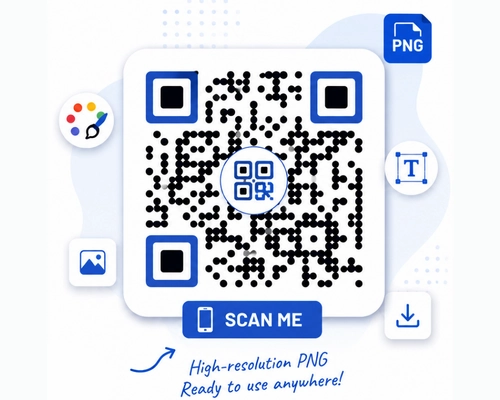
A QR code PNG is a QR code saved as a standard pixel-based image. It works well on websites, social media, email signatures, business cards, menus, and flyers.
Enter your content in the IMQRScan QR Code PNG Generator, customize the design, and download the PNG file. No account is needed for a basic static QR code.
Create a Free QR Code PNGA QR code PNG is a scannable QR code stored in the Portable Network Graphics format. PNG is a raster format, so it uses a fixed grid of pixels. It supports lossless compression and transparent backgrounds.
PNG is the same image format commonly used for logos, screenshots, website graphics, and other digital images. IMQRScan creates the QR code and lets you export it as a PNG file that can be added to a website, document, presentation, email, or social media design.
PNG is a lossless raster image format that can support transparency. Developers and designers can read the official PNG specification published by the World Wide Web Consortium.
The generator supports common content types, including:
Download one PNG and use it in the tools and platforms you already work with.
PNG stands for Portable Network Graphics. It is a raster image format, which means the image is made from a fixed grid of pixels.
A QR code saved as PNG looks like any other QR code, but the underlying file behaves like a photo or screenshot rather than a scalable vector graphic.
This matters because a PNG has a fixed resolution. If it is enlarged too far beyond its original dimensions, the edges may begin to look soft, blocky, or uneven.
For websites, social media, presentations, email, and moderate print sizes, this is rarely a problem. For large-format printing, an SVG QR code is normally the safer choice.
Paste a website URL, type plain text, enter WiFi credentials, add a phone number, or choose another supported QR code type and enter the required information.
Set the module and background colours, add a logo, choose a frame with a short label, and select a square, rounded, or dot-style pattern.
Choose PNG from the download options. The file saves to your device and can be used in websites, documents, design tools, email clients, presentations, and social platforms.
Download the QR code at a larger pixel size than you expect to display it. Do not enlarge a small PNG inside your design software. Keep a clear margin around the code, use strong contrast, and test the final version before publishing or printing.
For most websites, documents, business cards, menus, presentations, websites, and standard flyers, the PNG export is ready to use.
You normally do not need to change advanced image settings for everyday uses. Place the downloaded file in the final layout and display it at or below its original pixel dimensions.
Professional printing may have different requirements. Before printing a large poster, sign, banner, or high-volume product package, confirm the required pixel size and physical dimensions with your designer or printer.
For banners, oversized signs, and designs that will be repeatedly resized, use the QR Code SVG Generator instead.
The best PNG size depends on where the QR code will appear.
These suggestions are practical starting points, not fixed rules. Scan quality also depends on data density, contrast, print quality, viewing distance, and the phone being used.
| Use | Suggested PNG width | Important note |
|---|---|---|
| Website or landing page | 500 to 1,000 px | Display it smaller than its original size |
| Email signature | 300 to 600 px | Test it on desktop and mobile |
| Social media graphic | 600 to 1,200 px | Check it after platform compression |
| Business card | 600 to 1,000 px | Keep a clear quiet zone |
| Flyer or menu | 1,000 to 2,000 px | Test the printed version |
| Large poster | 2,000 px or more | SVG may be safer when enlarged |
| Banner or billboard | Use SVG | PNG may lose sharpness when scaled up |
A PNG between 500 and 1,000 pixels wide is usually enough for a website or landing page. Upload a larger source image and display it at a smaller size to help it stay sharp on high-resolution screens. Avoid unnecessarily large files that slow down mobile pages.
A PNG between 300 and 600 pixels wide is a practical starting point. Display it smaller inside the signature and test the received image in Gmail, Outlook, Apple Mail, and on a phone when possible.
The physical print size matters more than pixel width. Around 2 cm by 2 cm may be a useful starting point for a simple code scanned at close range. Dense QR codes may require more space.
A PNG between 1,000 and 2,000 pixels wide is a useful starting point for flyers, table cards, menus, and similar materials. Print one sample and test it before producing a large batch.
PNG can work for normal posters when the source image is large enough. For large signs, banners, or designs that will be repeatedly resized, use SVG to preserve sharp vector edges.
PNG and SVG can contain the same QR code. The difference is how each format stores the image and what happens when it is resized.
| Feature | PNG | SVG |
|---|---|---|
| Image type | Raster, pixel-based | Vector, shape-based |
| Quality when enlarged | Can become blurry | Vector QR pattern remains sharp |
| Best for | Websites, email, social media, and normal printing | Large signs, banners, and professional design |
| Transparency | Supported | Supported |
| Easy to upload | Yes | Depends on the platform |
| Editing | Limited pixel editing | Editable in compatible vector tools |
| Recommended default | Yes, for most users | Best when scaling is important |
Choose PNG for websites, emails, presentations, social media, menus, business cards, flyers, and other standard-size printed materials.
Choose SVG when a designer needs to enlarge, professionally edit, or repeatedly resize the QR code for signs, banners, and large-format printing.
Need to compare PNG with SVG, EPS, PDF, and JPG? Read the complete QR Code Format Guide .
PNG describes the image format. It does not decide whether the QR code is static or dynamic.
A PNG file can contain either type.
A static QR code stores the final information directly inside the QR pattern.
After the code is created, its stored content cannot be changed. You must create and download a new QR code if the information changes.
Static codes are useful when:
Learn more about creating a static QR code .
A dynamic QR code usually points to a short redirect address. The final destination can be updated without changing the visible QR code pattern.
You can download a dynamic QR code as a PNG image just like a static QR code.
Dynamic codes are useful when:
A PNG QR code works like a normal image file. You can upload, insert, resize, and position it in most website builders, document editors, email clients, and design tools.
Upload the PNG to the WordPress Media Library and add it with an Image block. Do not enlarge a small source file. Add descriptive alt text and test the QR code from the published page on desktop and mobile.
Open Insert, choose Pictures, and select the PNG. Resize it with a corner handle. Use print preview and scan a printed test page before producing more copies.
Open Insert, select Image, and upload the PNG. Choose a layout that keeps text and graphics away from the quiet zone.
Use Insert and Pictures to add the PNG. Keep it large enough for the audience and test it while the slide is displayed in presentation mode or through the projector.
Insert the PNG through your email signature settings. Keep the displayed size modest and test the received signature in different email services and on mobile.
Place the PNG inside the complete social media design. You can create one with our Social Media QR Code Generator. Keep it large, use strong contrast, and scan the final published version because social platforms may resize or compress images.
A sharp PNG file does not automatically guarantee a successful scan. The size, design, background, destination, and final placement also matter.
Dark QR code modules on a light background are the safest choice. Avoid using similar colours for the QR pattern and background.
Do not crop the empty margin around the code or cover it with text, borders, icons, photos, or other design elements.
Increase the physical size as the expected scanning distance grows. Dense codes containing more data may also need more space.
A large logo can cover important QR modules. Keep the logo modest and test the completed design on several phones.
Place the code over a plain area with strong contrast. Add a simple light panel behind it when the underlying photo or design is too detailed.
Rounded dots and custom shapes can work, but changing too many visual elements may reduce scanning reliability.
Make sure the linked page loads quickly, uses readable text, has a clear next action, works without zooming, and uses HTTPS.
Test the final design on at least two phones, at the expected distance, after platform compression, and on a printed sample when applicable.
Keep the width and height proportional when resizing the PNG. Stretching the image horizontally or vertically can distort the QR pattern and reduce scan reliability.
Use these checks when a PNG QR code looks blurry, loses its border, becomes difficult to scan, or changes inside a design tool.
The PNG may have been displayed or printed larger than its original pixel dimensions support.
Fix: Download a larger PNG and display it at a smaller size. For very large printing, use SVG.
The code may be too small, have weak contrast, lack a clear quiet zone, or contain a logo that covers too much of the pattern.
Fix: Test a standard dark QR code on a light background. Increase its size and test it without the logo or custom shape.
A cropping tool, image template, or design layout may have removed the quiet zone.
Fix: Restore the clear margin and keep text, photos, frames, and graphics away from the QR code edge.
The PNG may not have enough contrast against the surface or image behind it.
Fix: Use a plain high-contrast area or add a simple light background panel. For detailed background guidance, use the transparent QR code feature page.
A large logo may hide important modules or cover the three large position markers.
Fix: Reduce the logo size and test the completed QR code on several phones.
The physical printed size may be too small even when the image has a high pixel resolution.
Fix: Increase the physical size and print another sample. Pixel width and physical print dimensions solve different problems.
PNG works the same way regardless of what the QR code holds. These examples show how it can be used across common content types.
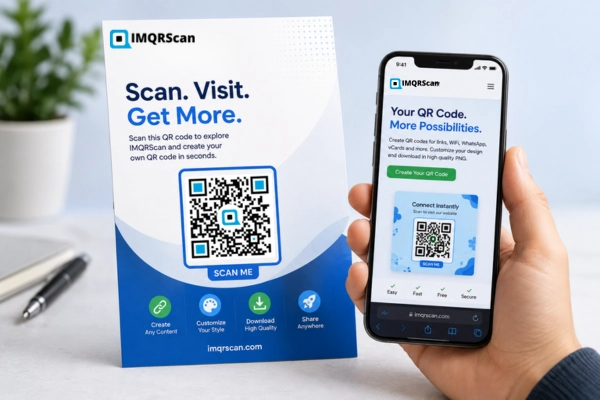
A QR code linking to a website, landing page, or online store can be added to a webpage footer, email signature, flyer, or digital graphic.
See the URL QR Code GeneratorA QR code that opens a WhatsApp chat works well on business cards, websites, digital advertisements, and customer support materials.
See the WhatsApp QR Code GeneratorA QR code linking to an Instagram profile is commonly used on packaging, posters, promotional materials, and social media kits.
See the Instagram QR Code GeneratorA QR code that connects a device to a WiFi network without typing the password works well on guest cards, counters, and office signage.
See the WiFi QR Code GeneratorA QR code containing a name, phone number, email address, and company details is useful in email signatures and digital business cards.
See the vCard QR Code GeneratorA QR code linking to a digital menu fits easily on table cards, takeaway packaging, window stickers, and restaurant signage.
See the Restaurant Menu QR Code GeneratorPNG is a standard format for web images. A QR code PNG embeds easily into a webpage and is widely supported across browsers, devices, publishing systems, and website builders.
A high-quality PNG image can print clearly on standard flyers and normal posters. For oversized posters or signs, consider SVG to reduce the risk of softness after enlargement.
Business cards are normally small enough that a properly sized PNG works well. The QR code can be added to most business card templates and common design applications.
Table cards, takeaway packaging, product labels, and restaurant materials normally use QR codes at sizes that work comfortably with a good-resolution PNG.
PNG is widely accepted by email clients and signature editors. Keep the displayed size modest and test the received message across desktop and mobile devices.
PNG is suitable for Instagram, LinkedIn, Facebook, presentations, and other digital graphics. Keep the QR code large enough to remain clear after compression.
Yes. PNG supports transparency, so the downloaded QR code image can be used without a solid white image background.
This is useful when placing the PNG inside branded layouts, presentations, websites, social graphics, or design software. The QR pattern must still contrast clearly with the surface behind it.
Use the dedicated background-removal page for guidance on contrast, white QR codes, image overlays, Canva layouts, and scan-safe placement.
Open the Transparent QR Code GeneratorCreate, customize, and download a sharp PNG QR code from one simple online tool.
Create PNG QR codes for supported links, text, WiFi details, WhatsApp links, contact information, social profiles, digital menus, and more.
Customize colours, frames, labels, dot styles, and logos before downloading the QR code.
Use the downloaded PNG in websites, documents, presentations, email signatures, social media, and printed materials.
Choose SVG when you need a scalable vector file for signs, banners, packaging, or large-format printing.
Create a dynamic QR code when you need editable destinations, campaign management, or scan tracking.
Download basic static PNG QR codes with no watermark and no account required.
Add your content, customize the design, and download a sharp PNG file for websites, digital graphics, business cards, menus, flyers, and other everyday uses.
Free, no credit card required.
Use the specialist feature page when you need a scalable vector format, more design control, a transparent background, or an editable QR code destination.
Create and download a scalable SVG QR code for packaging, labels, posters, signs, banners, and professional print layouts.
Explore featureCustomize colours, logos, frames, labels, shapes, and other design elements to match your brand or campaign.
Explore featureCreate a QR code with a transparent background for branded layouts, product images, coloured designs, and marketing materials.
Explore featureUpdate the destination after printing, measure scans, and manage changing links without replacing the visible QR code.
Explore feature