How to Make a QR Code for WiFi in 4 Steps
Step-by-step guide to making a WiFi QR code that works on iPhone and Android. Free, browser-based, with WPA3 support. Print-ready in under two minutes.
Quick Answer
To make a WiFi QR code, open the IMQRScan WiFi QR code generator, enter your SSID and password, choose the encryption type, then customise and download the QR as PNG, SVG, or PDF.
Table of Contents
Create a WiFi QR Code
Enter your SSID, password, and encryption type, then download a print-ready QR code.
Create Free WiFi QR CodeKey Takeaways
- Making a WiFi QR code takes about 90 seconds if you have the SSID, password, and encryption type ready.
- The same WiFi QR works on iPhone, Samsung, Pixel, OnePlus, Xiaomi, and most modern Android phones.
- Use a guest network for any QR code that will be printed or visible in a public or shared space.
- SVG is the best download format for printing because it stays sharp at any size.
- Always test the QR on a phone before printing in volume.
Making a QR code for your WiFi takes about ninety seconds once you have your network details. The process is the same on Windows, Mac, iPhone, and Android because the IMQRScan WiFi QR code generator runs entirely in your browser.
This guide walks through it step by step, then covers the small details that decide whether your printed QR actually scans on the day you need it: how to find your encryption type, the right print size, and the mistakes that quietly produce QRs that look fine on screen but fail on a guest's phone.
If you already know what you are doing and just want the tool, jump to the IMQRScan WiFi QR code generator. If you would rather understand what you are encoding before you encode it, read on.
What You Need Before You Start
Before you make the QR, collect the network details that will be encoded into the QR pattern.
WiFi network name
Your WiFi network name, also called SSID. Spell and capitalise it exactly as it appears on the network - "HomeWiFi" and "homewifi" are different networks as far as a phone is concerned.
WiFi password
The WiFi password for the network you want to share. Special characters, spaces, commas, semicolons, quotes, and backslashes can be encoded correctly.
Encryption type
The encryption type the network uses - usually WPA2, WPA3, or WPA2/WPA3 mixed. We will show you how to find this if you do not know it.
Main or guest network
A clear decision on whether you are sharing your main network or a guest network. For anything printed and visible to people you do not personally trust, use a guest network.
How to Make a WiFi QR Code in 4 Steps
Step 1: Open the IMQRScan WiFi QR code generator
Visit the WiFi QR code generator. IMQRScan helps you create a WiFi QR code directly in your browser. Always review the generated QR and avoid sharing your main network credentials publicly.
There is free signup and no watermark on the downloaded QR.
Step 2: Enter the SSID and password
Type the network name into the SSID field exactly as the router broadcasts it. WiFi names are case-sensitive "Cafe-Guest" will not match "cafe-guest." Then enter the password. Special characters and spaces are allowed and will be encoded correctly. If the password contains a backslash, semicolon, or comma, the generator handles the escaping automatically.
Step 3: Choose the encryption type
Select the encryption that matches your router. The most common options:
- WPA2 used by most home networks set up between 2006 and 2020.
- WPA3 the current standard for routers from 2019 onwards. Required for Wi-Fi 6E and Wi-Fi 7.
- WPA2/WPA3 mixed the most compatible option, supports both old and new client devices. This is the safe default if you are unsure.
- WEP only for very old hardware. Avoid unless you absolutely must support a legacy device.
- None for open networks with no password, rare for private use.
Step 4: Customise and download
Add a logo if you want one, pick brand colours if you have them, and download. PNG is fine for digital sharing. SVG is the right choice for anything you intend to print, because vector files stay sharp at any size. PDF is useful if you are handing the file to a print shop.
That is the entire process. Test the downloaded QR by scanning it from your phone before printing in volume, open your camera, point at the screen, tap the connection prompt. If it joins, you are done.
WiFi Encryption Options
| Option | Best For | Notes |
|---|---|---|
| WPA2 | Most home routers | Widely compatible |
| WPA3 | Newer routers | Stronger security |
| WPA2/WPA3 Mixed | Most users | Best compatibility |
| WEP | Legacy devices only | Not recommended |
| None | Open networks | Avoid for private use |
How to Find Your Encryption Type in 30 Seconds
If you are not sure whether your network is WPA2, WPA3, or mixed, here is the fastest way to check on each platform:
On Android
Settings → Connections, or Network and Internet → WiFi → tap the connected network. The Security or Encryption type is listed in the network details. Common values are "WPA2-Personal," "WPA3-Personal," or "WPA2/WPA3-Personal."
On iPhone
Settings → WiFi → tap the (i) next to the connected network. iOS does not always display the encryption directly, if you do not see it, check the router admin page instead, or default to WPA2/WPA3 mixed when generating the QR.
On the router admin page
Sign in at 192.168.1.1 or 192.168.0.1, or whatever address your router uses, and look under Wireless → Security. The page will tell you the exact security mode of each band, including 2.4 GHz and 5 GHz.
Common Mistakes to Avoid
Wrong SSID capitalisation
Phones treat "HomeWiFi" and "homewifi" as different networks. Copy it exactly from the router or from your phone's connected network info.
Selecting WPA2 for WPA3-only
Newer routers in WPA3-only mode will reject a WPA2 connection request. If in doubt, choose WPA2/WPA3 mixed.
Sharing your main network
This is the single biggest unforced error. Set up a guest network for any QR that will be printed or visible in a shared space.
Printing the QR too small
Below 2 × 2 cm, scan reliability drops sharply, especially on older phones. Use 4 × 4 cm or larger for signs and stickers.
Skipping the quiet zone
The 4 mm of white space around the QR is part of the spec. Decorative borders that touch the modules will reduce scan reliability.
Low contrast
Light-grey-on-white QRs look modern and scan badly. The dark colour of the pattern must be substantially darker than the background.
Glossy laminate
Glossy laminate reflects ambient lighting and causes scan failures. Matte or satin laminate scans far more reliably.
How to Print a WiFi QR Code Sign
A WiFi QR is only useful if it scans on the day. The QR code in print specifications below are based on the IMQRScan team's own scan testing across roughly 200 phone models, and are conservative enough to work in real-world conditions rather than just under studio lighting.
Sizing by Use Case
| Use case | Recommended QR size |
|---|---|
| Home WiFi card, fridge sticker, or router label | 4 × 4 cm or larger |
| Office reception, meeting room, or shared workspace sign | 5 × 5 cm or larger |
| Welcome card, rental card, or small handout | 2.5 × 2.5 cm minimum, ideally 3 × 3 cm |
| Wall sign or poster scanned from 1-2 m | 8 × 8 cm to 10 × 10 cm or larger |
Materials and Finish
Choose matte or satin lamination over glossy. Glossy QRs can fail under glare, window reflection, or low indoor lighting. PVC stickers and laminated cards both work well; uncoated paper is fine for short-term use but degrades quickly with handling.
Frame Copy
Add a short call-to-action above or below the QR. "Scan to connect to WiFi" is universally understood. "Free WiFi - scan to join" works for offices, rentals, and shared spaces. Avoid putting the SSID and password in plain text next to the QR; the whole point of the QR is that visitors do not need to type them.
Examples by Use Case
The same generator works for every situation; the only thing that changes is what you do with the QR afterwards. Five of the most common deployments:
Homes and guest networks
Create a QR for your home guest network and place it near the router, on a fridge card, or in a welcome folder so visitors can connect without asking for the password.
Airbnb and short-term rentals
A single laminated card on the kitchen counter with the property's name in the centre logo. Hosts who manage multiple units generate one QR per property and stop retyping passwords into guest messages forever.
Offices and meeting rooms
Reception desk, conference rooms, and visitor passes. Combined with a guest VLAN, this is the standard pattern for letting external visitors use the network without involving IT for individual credentials.
Events and conferences
Lanyards, programme inserts, and venue signage. With logo upload, the WiFi QR doubles as a sponsorship slot, the QR carries the event organiser's logo or a partner mark in the centre.
Clinics, salons, and waiting areas
Anywhere visitors wait more than a few minutes, a WiFi QR significantly reduces interruptions and keeps staff focused on the people in front of them.
For table tents, menus, receipt cards, cafe counters, and hospitality-specific placement, read the WiFi QR code guide for restaurants and cafes.
Want to create one now?
Use the free IMQRScan WiFi QR code generator to enter your SSID, password, and encryption type, then download a print-ready QR code.
Create Free WiFi QR CodeHow this guide is maintained
The IMQRScan team uses the same generator described on this page in our own offices, on our own devices, and at our partner events.
The print specifications above are based on practical scan testing across different phone models, screen sizes, lighting conditions, and print formats, with results reproduced under varied lighting conditions. Router-specific instructions are validated against the latest admin interfaces.
Last reviewed: May 2026.
Frequently Asked Questions
Quick answers about making WiFi QR codes, iPhone support, Android support, file formats, printing, passwords, and editing after print.
Ready to make your WiFi QR code?
Create Free WiFi QR Code →Related WiFi QR Code Guides
Continue with the WiFi QR tool, safe password sharing, general setup tips, use case, and scanning instructions.
WiFi QR Code Generator
Use the tool itself to create a printable WiFi QR code for your network.
Open Tool
WiFi QR Code Without Password
Learn what is possible, what is not, and how guest networks help with sharing safely.
Read Guide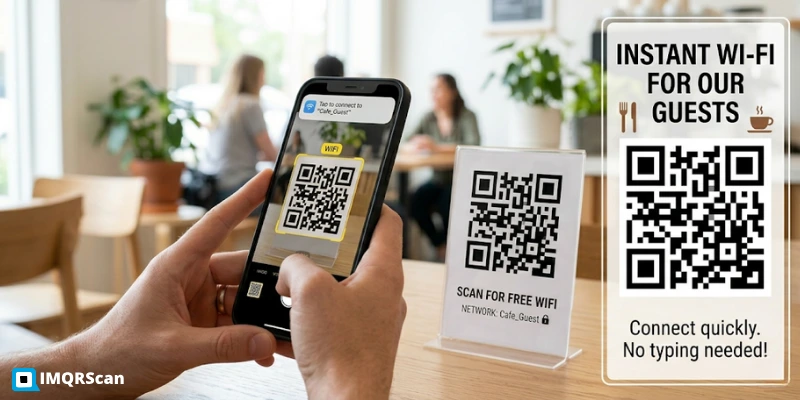
WiFi QR Codes for Restaurants
A hospitality walkthrough for WiFi QR codes in cafes, restaurants, hotels, and guest areas.
Read Guide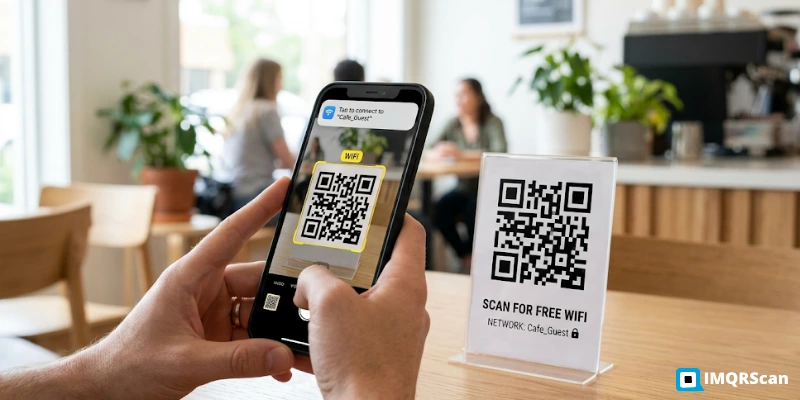
Scan WiFi QR Codes
Learn how to scan WiFi QR codes on iPhone, Android, Samsung, and laptops.
Read Guide